Neuroplasticity: Why Your Brain Is More Adaptable Than You Think

If chronic stress changes us biologically, an obvious question follows: Can we change back? The answer is one of the most hopeful discoveries in modern neuroscience.

Our brains are not static organs that finish developing in early adulthood and then simply decline with age. They are living, dynamic systems that continue responding to our experiences throughout our lives.
Neuroscientists call this remarkable capacity neuroplasticity.
Neuroplasticity is the brain's ability to reorganize itself by forming and strengthening neural connections in response to our experiences, behaviors, thoughts, and environment. For much of the twentieth century, scientists believed that once we reached adulthood, the brain's structure was largely fixed. Although we could continue learning new information, meaningful changes to the brain itself were thought to be limited.
Over the past several decades, that understanding has been fundamentally rewritten. Advances in neuroscience, together with thousands of studies demonstrating neuroplasticity across the lifespan, have shown that the adult brain remains remarkably adaptable. We are continually being shaped by the lives we are living.
One of the primary ways the brain changes is by recognizing patterns.
Every experience we have strengthens certain neural pathways. The thoughts we repeatedly return to, the emotions we habitually experience, the habits we practice, the relationships we cultivate, and the environments we spend our time in all leave their imprint on the brain. Over time, the brain becomes more efficient at whatever it is asked to do most often.
Neuroscientist Donald Hebb captured this principle with what has become one of the most influential ideas in neuroscience:
"Neurons that fire together wire together."
Although the phrase is elegantly simple, its implications are profound. The brain doesn't distinguish between what we intentionally practice and what life repeatedly asks us to experience. It simply becomes better at whatever circuits are activated again and again.
This is what makes neuroplasticity both such a cautionary tale and such a hopeful one.
Unfortunately, chronic stress becomes a pattern too.
When the nervous system spends months - or years - anticipating pressure, conflict, uncertainty, or danger, the brain becomes increasingly efficient at recognizing those experiences. From an evolutionary perspective, this makes perfect sense. A brain that quickly detects potential threats is a brain that keeps us alive. The problem is that modern life often asks our stress response to remain switched on far longer than it was ever designed to.
Over time, vigilance can begin to feel like our default setting. We become more reactive, less able to recover, and increasingly likely to interpret ambiguity through the lens of threat. This doesn't mean the nervous system is broken. Quite the opposite. It means it has adapted extraordinarily well to the conditions it has repeatedly encountered.
Understanding this changes the way we think about burnout.
Burnout is not the result of a personal deficiency or a lack of resilience. It is the predictable consequence of a nervous system that has spent too long adapting without enough opportunity to recover.
Fortunately, the same principle works in the other direction.
If repeated experiences of stress can strengthen pathways of vigilance, repeated experiences of safety can strengthen pathways of regulation. Every slow breath, meaningful conversation, walk through nature, moment of genuine presence, and experience of feeling safe in our own bodies gives the nervous system new information about the world it inhabits.
These moments may seem small in isolation, but the brain is paying attention. Over time, they become patterns as well. New neural pathways begin to strengthen, allowing calm to become more familiar than vigilance, regulation more accessible than reactivity, and connection more instinctive than protection.
This is the extraordinary promise of neuroplasticity.
We cannot erase the experiences that shaped us, but neither are we permanently defined by them. The brain we carry into tomorrow is, in part, the product of the experiences we create today.
This understanding sits at the heart of everything I teach through Lifeforce Labs.
Whether I'm leading corporate workshops on burnout prevention, speaking with leadership teams about resilience, guiding retreats, or teaching public classes, my goal is always the same: to help people understand the biology of stress while offering practical, evidence-informed ways to support nervous system regulation. When we understand how the brain changes, we stop viewing resilience as something we either have or don't have. Instead, we begin to see it as something we can intentionally cultivate through the experiences we repeatedly give ourselves.
Perhaps that is the most hopeful lesson neuroscience has offered us.
Our past influences us, but it does not imprison us. Every day, our brains continue listening, adapting, and changing. The question is not whether they will change.
The question is: What are we teaching them?
Upcoming Workshop

From Burnout to Radiance: Returning to Your Natural Rhythm
Saturday, August 29, 2026
3:30 PM - 5:30 PM
Metta Yoga Studio, San Rafael, CA
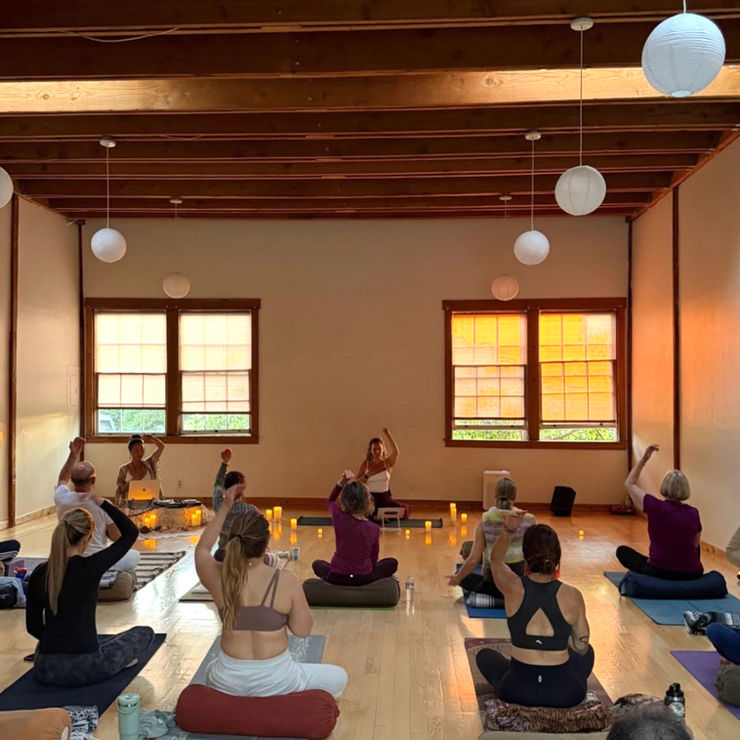
Blending somatic practices, Kundalini yoga, breathwork, and mantra-based meditation, this workshop teaches the tools needed to move beyond survival mode and reconnect with your inner radiance and vitality.
Weekly Classes Experience the Lifeforce Method: Kundalini yoga for modern life.

Wednesdays — 7:35 pm
Metta Yoga, San Rafael
A 60-minute mid-week sanctuary for body, mind, and soul.

Ways to Work Together
Work with Alison through private sessions and couples experiences, or bring The Lifeforce Method™ to your organization with workshops and offsites.
Lifeforce Labs
Empowering your vitality through science and spirit.
Lifeforcelabs.org | alison@lifeforcelabs.org


Comments